“Jugadores, jugadores hoy vinimos a alentar. San Lorenzo es de primera y de primera no se va!” We are singing again but to a much smaller audience of people riding a Buenos Aires bus. An older lady at the back of the bus sparked our latest outburst after she began an older San Lorenzo song when she saw our blue and red colours get on the bus. As soon as we finished one song, some one would start the next one and we kept singing. The San Lorenzcista clapped along while grinning and ignoring her husband who kept saying “and Nuevo Chicago too!” every time she said “vamos cuervos!” Normally, despite being dressed in the uniforms of an hincha of San Lorenzo, my friends are reserved on the streets of Buenos Aires; keeping the terrace culture to the stadium. I also usually pay more attention to how 'the public' reacts to the sight of our group of hinchas but in this moment I didn't care – we laughed and sang the whole ride. Three hours after the match our emotional high had yet to fade: San Lorenzo defeated San Martin of San Juan 3-1 and passed a defeated Banfield to escape direct relegation. We were celebrating being in the “promoción” as if we'd seen the players lift the league cup, which incidentally went to Arsenal de Sarandí on the same night.
Showing posts with label Sufrir. Show all posts
Showing posts with label Sufrir. Show all posts

28.5.12
Crying for a Victory
At the moment there are few words to explain the emotional low to high of yesterday's match. Starting the match in the direct relegation, San Lorenzo, at home, needed to win again Newell's Old Boys of Rosario - a team at the other side of the table fighting for first place. Few other clubs can claim to have 30 000 supporters when their team sits in the lower middle-half of the table and fighting relegation; the anticipation in the stadium was palpable. Newell's first goal was a deep cut into the spirit of the nearly sold out Nuevo Gasómetro. The second caused hundreds, more likely thousands, of fans to break down into tears. Those who weren't crying were left to sardonic and sarcastic comments about their upcoming chance to 'see Argentina' - a reference to the travelling to the remote teams in the Nacional B tournament. During the 15 minutes between halves it was the only defence for many against the deep depression of facing three more and final matches in the Primera.
What happened next has been described as a 'miracle' and is worth seeing the full 10 minutes of highlights:
Vindication started for the player worthy of a large share of the first half scorn; Emmanuel Gigliotti had been eating up goal scoring chances, unable to put the ball into the back of the net or run more than 10m to win it back. But for every 45 minutes of playing as a 'burro' (mule), he manages to be a striker for an all important moment. He finished with the all important first and third goals.
Carruso, the technical director for San Lorenzo, made the necessary changes during the second-half bringing on "Pipi" Romagnoli - already a Ciclón legend from 2001 and starting on the bench because of a ongoing injury - and Carlos Bueno, the Urguayan striker for defender Alvarado. Buffarini - the ongoing savoir and stadium favourite of San Lorenzo in this tournament - was dropped back into right defence but with the determination to play anywhere on the pitch that gave his team the advantage. Running up the wing, it was Buffarini's perfectly placed cross that led to San Lorenzo's second all important goal off the head of "Charlie Good".
Gigliotti's third goal seemed to come out of the force-of-will of the thousands of supporters jumping and singing in the popular section. An explosive rupture in the tension marked by "GOOOOOOOOOOOOOOOL" followed; I must have been one of the few within the 30 000 incapable of reacting spontaneously with a river of tears. Friends and complete strangers everywhere, except the completely silent visitor section, were huddled in euphoric embraces, and in some cases precariously tumbling piles of bodies - fear and caution not being emotions worthy of the moment. In the final 8 minutes, the united hinchada of the Butteler sang with every ounce of voice left, only becoming silent minutes after the final whistle when its thousands of vocal chords and emotional highs finally gave out. Even after the gates were opened for the local side, many could not or did not want to leave the stadium, some were still in tears 20 minutes after the match.
San Lorenzo has not been 'saved' - the religious language appropriate for a such-named team of 'suffering' - and has yet to play direct rivals in the fight against relegation: Tigre away in two weeks. A difficult match, politically and footballistically, and without Buffarini, out on five yellow cards. For now, San Lorenzo is living in a miracle but three matches remain. Everyone is as important as a cup final.
9.4.12
'Clasico de sufrimiento'

El Clasico de San Lorenzo - Racing no tuvo un nombre 'oficial' como "superclasico" o "clasico de Avellaneda" antes ahora. Para mi, es claro que esta noche ellos vayan a jugar un clásico de sufrimiento y esperanza. Un club tiene un nuevo técnico, el otro un técnico que pueda ir después de hoy. Los dos están muy lejos de ser campeón con intereses a mantener su posición en la A. Si San Lorenzo ganaré puede superar unos equipos en el ascenso y Racing tiene la oportunidad a ganar tres puntos importante para el año que viene.
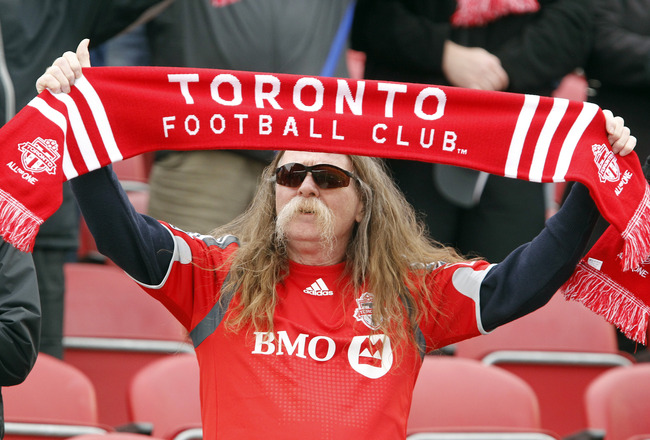
Y en reconocimiento de este 'clasico de sufrimiento' voy a llevar mi camiseta de Toronto FC; a ser hincha de TFC está en el diccionario bajo la palabra "sufrir".
____
Today is the "Clasico" between San Lorenzo de Almagro and Racing Club de Avellaneda. Unlike the 'superclasico' or 'clasico de Avellaneda', this clasico doesn't have a name. As I see it, tonight they will be playing the clasico of suffering and hope. One club, San Lorenoz, has a new manager, while Racing's could lose his job after tonight. Both are very far from the top of the table and are focused on staying in the Primera A. If San Lorenzo wins, they will rise in the ascenso while Racing needs the three points for next year's ascenso.
In my opinon, Carusso, San Lorenzo's new manager, is crazy. Maybe this is what San Lorenzo needs to win the final matches of the season but they need all the luck that they haven't been getting this year. They can only with their suffering with the hope that tomorrow they will be better.
In honour of the "clasico of suffering" I'm going to wear my TFC jersey, because in the dictionary below the word "suffer" is the definition "to be a supporter of TFC".
Image from: http://playfutbol.infobae.com/notas/641162-Racing-San-Lorenzo-un-clasico-de-necesitados-y-que-tendra ; http://bleacherreport.com/articles/1122548-struggling-reds-to-battle-mexican-power-santos-in-concacaf-semi-final-play
29.3.12
San Lorenzo es un equipo de sufrimiento
It is uncommon in Buenos Aires to encounter a taxi driver who does not associate with Boca or River. Not impossible: I've met taxi drivers from Racing, Independiente and even a handful from San Lorenzo; but uncommon. A taxi driver outside of the 'big five' is very rare. Taxi drivers are, at least in their football teams, representative of Argentine society.
In my first months in Buenos Aires, taxi drivers easily identified that I was not from the country (I can now give my address with a sufficient accent that their interest is not piqued). Conservation invariably reached the question: “what are you doing here?” and to football. Given the composition of taxi-drivers, I did not receive too much sympathy for my team choice. More, however, than an Argentine would.
Descriptive labelling is integral to Argentine conversation. Person's names are often replaced by ambivolent physical descriptions: “¡ey flaco!” “¿que tal gordo?” “bien bien, ¿y vos negro?” (Suaréz wasn't making up his defence from nothing, 'negro' is often used). Foreign players, and foreign immigrants, are often called by their nationality. Examples of San Lorenoz players: Ortigoza is called “el Paraguayo” and Salguiero is “el Uruguayo”. It is not always positive but unlike such labelling in North America it is also not always negative.
Hinchadas of football teams are also reduced to several descriptive labels. The most common and one of the most insulting is to say 'pecho frio' – literally cold chest, but I think cold heart is a more accurate translation. Vélez Sarsfield is the classic example – if they are losing “la gente” (people) don't go. At least that is how non-Vélez supporters see it. It may be jealousy, as Vélez has been consistently good since the 1990s. Nevertheless, for most hinchas what is worse than having a losing team is to have an hinchada that does not show its support through the 'buenas y en las malas mucho más' (in the good and in the bad, even more).
Two teams that don't consistently earn the label of 'pecho frio' from Buenos Aires taxi drivers are Racing Club de Avellaneda and San Lorenzo de Almagro – first because both are large enough to general topics of discussion. Instead most will agree they are clubs 'de sufrimiento' – of suffering – spoken with the tone of grave sincerity but approving nod of the head. In a twisted world, suffering is seen as an undesirable but admirable trait. In footballing terms, it means that people show up in the stadium to see their team lose.
And San Lorenzo is living up to its label this year. Last weekend I travelled to Rafaela, Santa Fe with buses organized by supporters – it is a seven hour trip of singing and drinking, on the way up at least. Around 600 people made the journey is a similar fashion (most from Buenos Aires and around, but others came from La Plata, Cordoba, Santa Fe, and other cities). We arrived early to pass the midday in a park. 600 cuervos eating choripan, relaxing in the autumn sun, sporadically groups launching into another song. While I heard people mention that they were nervous and anxious about the game, most came with an enduring hope that their collective presence would help lift their team.
 It wasn't going to be a good result, despite pulling thousands (including many locals and people who found their own way) to Rafaela, their support was not enough to pull San Lorenzo back into the match that they briefly were leading. The 2-1 loss to Rafaela is a disaster in terms of San Lorenzo's position in the decenso; the team is within a hair (or another Tigre victory to be precise) of the direct decenso. No opportunity for redemption at the end of the season if the ciclón's fall continues.
The flow of the match has a big impact on how supporters react. I'm finding that an hinchada is willing to sing in matches that are a complete disaster (Lanús) but are disillusioned and likely to fall silent if their moment of hope is snatched away. San Lorenzo supporters walked out of Rafaela without singing, without applauding or even swearing at their players. “Why are you clapping, they don't deserve anything” someone said. Silence from thousands of people is one of the most imposing sounds.
How much suffering can people take, however, before they reach their limits? There are 12 matches to be played, the next one against the pecho frios of Vélez – still standing near the top of the table – behind closed gates. The incidents from two weekends ago led AFA to suspend local supporters. San Lorenzo supporters have a lot of potential suffering to endure – given how this team is playing and the troubles going on behind the scenes. They are not going to get any breaks; in Rafaela there was again more controversy with penalties not called in San Lorenzo's favour.
But as the bostero or gallina taxi drivers will admit, to a foreigner at least, there is an Argentine dignity to enduring suffering. I think to suffer means you do not have a cold heart, even more literally: not dead. With suffering there is passion and life, thus optimism that at the very least tomorrow and “siempre te voy a acompañar” - I will always be with you.
Image from: http://larevistadelciclon.blogspot.com.ar/.
In my first months in Buenos Aires, taxi drivers easily identified that I was not from the country (I can now give my address with a sufficient accent that their interest is not piqued). Conservation invariably reached the question: “what are you doing here?” and to football. Given the composition of taxi-drivers, I did not receive too much sympathy for my team choice. More, however, than an Argentine would.
Descriptive labelling is integral to Argentine conversation. Person's names are often replaced by ambivolent physical descriptions: “¡ey flaco!” “¿que tal gordo?” “bien bien, ¿y vos negro?” (Suaréz wasn't making up his defence from nothing, 'negro' is often used). Foreign players, and foreign immigrants, are often called by their nationality. Examples of San Lorenoz players: Ortigoza is called “el Paraguayo” and Salguiero is “el Uruguayo”. It is not always positive but unlike such labelling in North America it is also not always negative.
Hinchadas of football teams are also reduced to several descriptive labels. The most common and one of the most insulting is to say 'pecho frio' – literally cold chest, but I think cold heart is a more accurate translation. Vélez Sarsfield is the classic example – if they are losing “la gente” (people) don't go. At least that is how non-Vélez supporters see it. It may be jealousy, as Vélez has been consistently good since the 1990s. Nevertheless, for most hinchas what is worse than having a losing team is to have an hinchada that does not show its support through the 'buenas y en las malas mucho más' (in the good and in the bad, even more).
Two teams that don't consistently earn the label of 'pecho frio' from Buenos Aires taxi drivers are Racing Club de Avellaneda and San Lorenzo de Almagro – first because both are large enough to general topics of discussion. Instead most will agree they are clubs 'de sufrimiento' – of suffering – spoken with the tone of grave sincerity but approving nod of the head. In a twisted world, suffering is seen as an undesirable but admirable trait. In footballing terms, it means that people show up in the stadium to see their team lose.
And San Lorenzo is living up to its label this year. Last weekend I travelled to Rafaela, Santa Fe with buses organized by supporters – it is a seven hour trip of singing and drinking, on the way up at least. Around 600 people made the journey is a similar fashion (most from Buenos Aires and around, but others came from La Plata, Cordoba, Santa Fe, and other cities). We arrived early to pass the midday in a park. 600 cuervos eating choripan, relaxing in the autumn sun, sporadically groups launching into another song. While I heard people mention that they were nervous and anxious about the game, most came with an enduring hope that their collective presence would help lift their team.

The flow of the match has a big impact on how supporters react. I'm finding that an hinchada is willing to sing in matches that are a complete disaster (Lanús) but are disillusioned and likely to fall silent if their moment of hope is snatched away. San Lorenzo supporters walked out of Rafaela without singing, without applauding or even swearing at their players. “Why are you clapping, they don't deserve anything” someone said. Silence from thousands of people is one of the most imposing sounds.
How much suffering can people take, however, before they reach their limits? There are 12 matches to be played, the next one against the pecho frios of Vélez – still standing near the top of the table – behind closed gates. The incidents from two weekends ago led AFA to suspend local supporters. San Lorenzo supporters have a lot of potential suffering to endure – given how this team is playing and the troubles going on behind the scenes. They are not going to get any breaks; in Rafaela there was again more controversy with penalties not called in San Lorenzo's favour.
But as the bostero or gallina taxi drivers will admit, to a foreigner at least, there is an Argentine dignity to enduring suffering. I think to suffer means you do not have a cold heart, even more literally: not dead. With suffering there is passion and life, thus optimism that at the very least tomorrow and “siempre te voy a acompañar” - I will always be with you.
Image from: http://larevistadelciclon.blogspot.com.ar/.
11.2.12
An Argentine definition of "sufrir"
The hinchada of San Lorenzo, along with Racing de Avellaneda, is broadly known for its suffering. Last night San Lorenzo lost 4-1 in a 30 minute defensive disaster.
Here is the response (you can hear San Lorenzo's goal, but it wasn't what mattered):
Unlike in English, in Argentina to recognize someone's 'suffering' is not to see only their problems; it is also to recognize their willingness to struggle against those problems.
Here is the response (you can hear San Lorenzo's goal, but it wasn't what mattered):
Unlike in English, in Argentina to recognize someone's 'suffering' is not to see only their problems; it is also to recognize their willingness to struggle against those problems.
Subscribe to:
Posts (Atom)