Pages

Showing posts with label Sanlore. Show all posts

7.8.12

The day that the football returns.

Professional football is returning to Buenos Aires and not soon enough. I admit my addiction has become overwhelming. A three week distraction travelling through Bolivia: seeing some of the world's finest sceneries and meeting people from fascinating cultures; was not enough. As my brother will half-jokingly tell you, “he misses football so much that we sat down in the centre of La Paz to watch two teams made of ladies from the market”. Besides the spectacle of organized women's football being an interesting gendered phenomenon in Bolivia, I did have to restrain myself from yelling “¡DALE! ¡CANTA!” at the restrained and for the most part quiet Bolivia audience. Even the more lively – if the four red cards and numerous yellows – of the professional Cochabamba 'clasico' between Wilsterman and Aurora has not satiated my hunger. Friends and families were divided between the azul-rojo of Wilsterman and the celeste-blanco of Aurora but sitting together. I don't think Bolivian football often elicits the passion, nor the violence, found in Argentina.
Clasico de Cochabamba
Luckily the break has been relatively very short, only one month compared to the long arduous four summer months that hockey fanatics endure. But one month is more than enough time for the drama to make many twists and turns. Following from a distance, trying to keep ahead of transfer rumours and backroom politics was difficult. I've returned to a club in political upheaval but apparently more secure footing on the pitch. Previous President Abdo and his Vice-President have renounced their positions and political factions – known as agrupaciones have been preparing their campaign lists for upcoming elections on September 1. The familiarity of Canadian snap elections.

In league play San Lorenzo was back at Nuevo Gasómetro last Sunday against San Martin of San Juan, a rematch of the final league match last year. With a new look. New jerseys – which are still ugly, poorly designed and too expensive for their quality, thank you Lotto – and new players. In 17 new faces as of today; gone is the overweight club of Bottinelli (controversially to River Plate), Gigliotti, Ortigoza (looking for the parrilla in the UAE as we speak), Bueno and Chávez (who is returning to Napoli's pizzarias). As you can tell my hope is that the addition of Juan Mercier, Furch, Prósperi, Franco Jara, Luis Aguiar, and Denis Stracqualursi will at least be a slimmer more committed team.

Sunday's 2-1 win was messy at times but did deliver an entertaining and more athletic first half. Goals for Pipi Romagnoli, who picked up the ball in the box while I was claiming “penalty” to place it neatly into the corner, and Jara came without the agony and force that seemed to be required last championship. Jara's celebrated his goal by climbing the fence in front of the hinchada, earning the title of “Jaraña” (play on the word for spider). On the less optimistic side, Stracqualursi showed haunts of Gigliotti, missing wide after running in on goal and the defence did get nervy in the second half against a team likely to be close to the bottom this year. But after so many changes, the team has only had one week together and hopefully these problems come from the lack of familiarity.

In the stadium, the hinchada had a 'new look' as well. Within the City of Buenos Aires, the large trapos -ribbon like flags- famous in Argentine stadiums have been 'banned'. Security officials for the city argue that illegal activities occur underneath the trapos because they obscure the watchful eye of the cameras – which seem to conveniently malfunction anyways. The trapos seem like a convenient symbolic target to cover up the reality that drugs and weapons enter the stadium through the 'watchful' eyes of hundreds of police officers each week. It will be interesting to see if such a ban holds and forces a slight change in the symbolic culture of the hinchadas. I doubt it will make the illegal activities any more visible.

The voice of the hinchada was as strong as ever; the loud boom-ba-ba-boom of the banda underlying the chorus of 25 000+ voices with the tribuna bouncing to the rhythm of thousands of jumping feet cannot be simulated anywhere else. The sunset behind the Platea Norte during the second half was spectacular. In the end, winning the first match without too much stress for once was comforting. Promedios are still a problem and plenty of matches to worry about.

Nuevo Gasómetro in all its 'under-construction' beauty
Off the field, everyone's focus is on the 'return' of Argentina's most famous TV personality: Marcelo Tinelli. Tinelli is a well known hincha of San Lorenzo, with millions of pesos to back up his interests in the club's well being. Olé reported that he was at the match last Sunday in his palco (box) after a three year absence – whether or not he actually had stayed away... when Tinelli wants to be seen and heard, the media gives him attention. Being a major financial source for many of transfers to the club, Tinelli has also manoeuvred into a political position behind his preferred interim President Mattias Lammens and receiving the position of first vocal on the new board of directors. Lammens and Tinelli are also organizing an agrupación, likely 'winners'. Interim President during elections becomes full time President, politics in football clubs.

One of Tinelli's biggest impacts, however, has come in the increase in socios and media attention for San Lorenzo. A few second plug on his top-rated, and at times easily mistaken soft-core porn, celebrity dance program Showmatch has created a sharp increase in the numbers of socios. Whether these people stay officially affiliated to the club for more than three months is a debate amongst the 'regular' hinchas. Being a 'real' hincha myself, with my abono-visitante and extreme travelling for San Lorenzo (to Salta twice in four months), I'll have to wait and see.

Football is back in Argentina; and just in time to distract from the low medal count at the Olympics. Canada may not be doing great but every Argentine is envious of our 10 medals. Unfortunately they missed the best football match/worst officiating this year: the Canada-US women's semi-final. Onto the Bronze ladies; its hard to beat 12 US players but you managed to take it to the 119th minute. 

26.6.12

San Lorenzo is from the Primera and in the Primera we'll stay


“Jugadores, jugadores hoy vinimos a alentar. San Lorenzo es de primera y de primera no se va!” We are singing again but to a much smaller audience of people riding a Buenos Aires bus. An older lady at the back of the bus sparked our latest outburst after she began an older San Lorenzo song when she saw our blue and red colours get on the bus. As soon as we finished one song, some one would start the next one and we kept singing. The San Lorenzcista clapped along while grinning and ignoring her husband who kept saying “and Nuevo Chicago too!” every time she said “vamos cuervos!” Normally, despite being dressed in the uniforms of an hincha of San Lorenzo, my friends are reserved on the streets of Buenos Aires; keeping the terrace culture to the stadium. I also usually pay more attention to how 'the public' reacts to the sight of our group of hinchas but in this moment I didn't care – we laughed and sang the whole ride. Three hours after the match our emotional high had yet to fade: San Lorenzo defeated San Martin of San Juan 3-1 and passed a defeated Banfield to escape direct relegation. We were celebrating being in the “promoción” as if we'd seen the players lift the league cup, which incidentally went to Arsenal de Sarandí on the same night.

24.6.12

Until the last breath... we are San Lorenzo

It is the night before. A cuervo's friend's facebook status currently reads: "Please open Bidegain [the Nuevo Gasómetro] now! If they open it we will fill the terraces to get through the night of the Azulgrana insomnia". I will be getting up early tomorrow (this?) morning to participate in the San Lorenzo pilgrimage to the virgin of Lujan and returning by noon. Hardly the longest journey to get to the Nuevo Gasómetro - the Peña de Salta are travelling over 1600 km or 20-plus hours to be in the stadium, which has been sold out completely. Over 39 000 anticipated local entrances. No matter the result, at the final whistle there will be a large collective gasp of air.
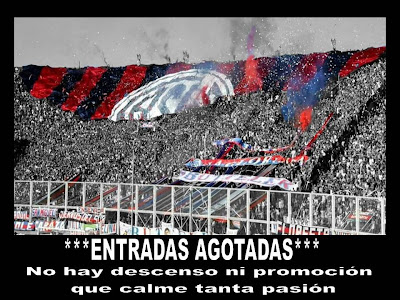
Sold out: No relegation or promotion can control such passion.
Rather than write my own last minute thoughts, I would rather translate some of the words of two of the thousands of San Lorenzo hinchas struggling to express themselves. Unfortunately I don't have too much time or energy at the moment, but I hope that these small excerpts illuminate the world in which my own emotions have been enveloped within.

One of the most famous hinchas of San Lorenzo is Viggo Mortenson. And by hincha, I do mean one of the hundreds of thousands who will attentively and emotionally invested in tomorrow's match. After loudly cheering the end of the San Lorenzo - Newel's match several weeks ago, Viggo was approached by Washington airport security and told to calm down. His passion leads him to contribute to a regular column, drawing widely from the storied history of the club. In his latest exchange, Viggo states his San Lorenzo:
El partido contra San Martín será emocionante, pase lo que pase, sea o no el último del torneo. Veremos si podemos ganar y después tener al menos la suerte de jugar dos partidos para quedarnos en primera. Como decís, Fabián, esperamos que nuestros hermanos y hermanas del CASLA procuren portarse dignamente en nuestra casa, canten lo que canten o digan lo que digan los del otro equipo. Tampoco hace falta recordarles a nuestros directivos, jugadores o al equipo técnico que vamos mal. Lo sabemos todos de sobra. Mi sincera esperanza es que alentemos y juguemos hasta el último suspiro como lo que somos: los más guapos del fútbol argentino.
The match against San Martín will be emotional whatever happens. Our only chance is if we win. Then with some luck there will be two more matches to see if we can stay in the Primera. As you say Fabián [Viggo's interlocutor], we hope that our brothers and sisters in CASLA carry themselves in our house with dignity, no matter what the other club may sing or say. Nor that our leaders, players or team forget that we are in a difficult time. We all know it. It is my sincere hope that through our cheers and play and till our last breath we truly show who we really are: the most beautiful in Argentine football.
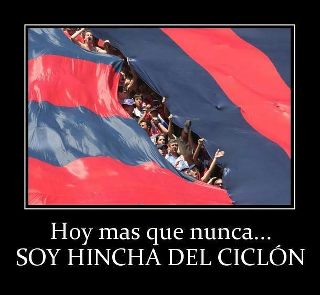
Now more than ever, I am an hincha of El Ciclón.
Pablo Jelovina wrote a letter to the players, which has since been posted on the San Lorenzo club website. In his last paragraph he writes:
Y así, cuando escuches el alarido salvaje de las tribunas, vas a poder entender que ese grito de guerra lo tenés en las entrañas. Que sale de tu más profunda voracidad como una bandada de cuervos dispuesta a sacarle los ojos al destino preanunciado. Porque vos, jugador de San Lorenzo, vas a sentir que por tu sangre corre nuestra hombría, nuestra ira, cada una de las esperanzas que, juntas, suman una realidad. Porque vos, hombre hecho ciclón, podés arrasar con cualquier tristeza, si te abrazás a nuestras lágrimas de ilusión
And when you hear the savage roar of the terraces you will understand in your guts this battle cry. Enter with the profound ferocity of a murder of crows determined to gouge the eyes of their foretold victim. You are a San Lorenzo player: you will feel running through your blood our manhood, our rage, every one of our hopes that together add up to a reality. You are a man made by the Ciclón. If you embrace our tears of hope you will be able to defeat any and every sadness.
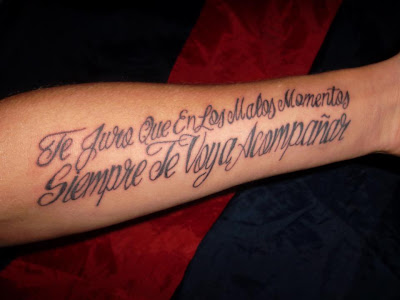
One hincha, though I suspect that there are many more, has etched onto their body their life long sentiment and commitment to San Lorezno:
I swear that in difficult times, I will always be with you.
So I wait for the gates of the Bidegain to swing open so that I can be beside and with all those who will be present with their hopes and passion.

Hasta el ultimo suspiro con todos nuestros lágrimas de ilusión somos San Lorenzo. ¡El Ciclón! ¡El Ciclón! ¡El Ciclón!

22.6.12

the true meaning of an hincha's hope


Sitting at a late-night cafe with cuervo friends, the topic of conversation has once again returned to the importance of hope and possibilities. “What more can you do? It's better to be hopeful and positive. I'd rather go to the stadium expecting the best. It's my opinion – what do I know?” states a friend. San Lorenzo has one game left to save itself. It is hard not to hear the resignation in their voices despite all efforts to find the positives. Reality, the poetic enemy of hope, for San Lorenzo is stark with their fate is only partially within their control.

An online survey by the popular mundoazulgrana.com.ar website over the past few days reveals the lack of optimism resignation of many cuervos. Most believe that San Lorenzo after this Sunday will be in one of two direct relegation spots and no possibility of salvation.

Expectations for the performance of the team have sharply dropped over the past two weeks. After an expected but demoralizing 3-1 defeat to Tigre in Victorino – the names ominous enough even before considering Tigre is currently sitting first while also carrying favour with the politicos of AFA – San Lorenzo's still was in control. Two victories in the last games would have guaranteed a fighting chance to stay in the Primera possibly even salvation. Unfortunately, the reality is San Lorenzo hasn't won two straight matches in over a year.

Last Sunday the group met under low and looming grey clouds. In Buenos Aires it is not the temperature of winter, it is the damp humidity that invades through your clothing which makes you feel cold. Little did we know, the miserable light drizzle would turn out to be a perfect fit for the 'spectacle' we were about to see. Independiente de Avellaneda vs. San Lorenzo de Almagro is supposed to one of the 'clasicos' of Argentine football. The 0-0 tie was probably the worst match I've seen this year by both teams. Standing at the top of Independiente's partially completed and ironically grafittied “¿estadio europeo?” I felt already emotionally prepared for what was to come. As we prepared for the match, the supporters seemed more concerned by the poorly placed San Lorenzo banners that blocked the view of the goal far below. And to hurled insults of “you are in the B” by Independiente, a friend responded in a moment of brain-to-mouth: “you'll join us next year!” before another friend chided him with a sardonic laugh “hey, hey, be careful what you say!”

There is not too much to say about the match itself, though a last-minute goal-line clearance after a comedy of errors by San Lorenzo may turn out to be a perfect metaphor and important moment in this year's tournament – if they stay in the Primera. As the referee blew the final whistle for the first time this year the majority of San Lorenzo's supporters headed directly to the exit without applauding the players. Mid-game as the hinchada tried to sing through the lines “todo juntos podemos, nosotros alentamos, ustedes pongan huevos” felt more like an angered plea falling on deaf ears. Sports commentaries function through simple metaphors: but It is easier to watch the team 'go down fighting' then to see resignation.

One of the most important expectations of an hincha is that their players “show their feelings for the colours” - losing comes after the indignity of watching and supporting a team going through the motions without playing with emotions. The driver of our group had threatened to not enter the stadium, earlier in the week explaining “After the Newell's game, where the players did nothing, it was the hinchada singing that basically won the match... like the song 'all together, we support and you play with guts' [my translation]... and everyone in the stadium was crying but most of the players don't feel this way. It just make me feel angry.” He nearly missed the game, dropping us off two hours before the match to avoid the murder of cuervos expected to be waiting outside of the stadium looking for extra tickets. He had given his ticket to a friend and our group entered without him. Only to see him again one hour later – how he got another ticket I'm not sure – climbing up the now half-full terraces. “Where else could I watch the game?” he said after I asked him.

It is not a cliche that such difficult moments create problems for the hearts of sports fanatics. Another friend three weeks ago spent several days in the hospital to have his arteries cleaned and missed the last two visiting matches. He'll be returning to the Nuevo Gasómetro this Sunday afternoon: “It would be worse for my heart if I was at home watching the game alone; I'd rather be with friends if they lose.” Which is not to say there is resignation to lose but the debates about possibilities and realities are beside the 'real' point.

And I think that is the feeling underlining the 'hope' for San Lorenzo fans: the need be with the club and all that it represents. There will be time later to fight over the politics of poor performances. In the past two days the ticket sales for the final match of the tournament have exploded. Yesterday there was a line-up five blocks long in the city centre office, two blocks at another location, to buy tickets. I imagine many fathers, uncles and older relatives who don't normally go to the cancha anymore will be holding those tickets, standing beside the family and friends that share their passion for their club. Hundreds, if not more, will wake early Sunday before the match to make a pilgrimage to the Basilica of Luján asking for a favour or some luck.

San Lorenzo de Almagro the club is transcending San Lorenzo the team. Hinchas are pleading among themselves through social media that difficult times need not lead to violence; to be different from the riots that followed River Plate's relegation last year.

"This Sunday, whatever happens, do not forget San Lorenzo de Almagro. The club is of the people of San Lorenzo, not the players nor the leaders; it is ours. Beyond the anger and sadness, together we will not hurt the club. Honour the San Lorenzo that we Cuervos deserve because no one else will. We remind ourselves what we think of those who destroy their own clubs. Be the example we always are. We are San Lorenzo; do not forget it"

Whatever happens on the pitch is bound to bring strong emotions for the tens thousands of Cuervos in the stadium (and many more watching on television) – elation at one more breath or great sadness – but all in the hope to share the experience with people who will understand 'what it feels like'.

28.5.12

Crying for a Victory

At the moment there are few words to explain the emotional low to high of yesterday's match. Starting the match in the direct relegation, San Lorenzo, at home, needed to win again Newell's Old Boys of Rosario - a team at the other side of the table fighting for first place. Few other clubs can claim to have 30 000 supporters when their team sits in the lower middle-half of the table and fighting relegation; the anticipation in the stadium was palpable. Newell's first goal was a deep cut into the spirit of the nearly sold out Nuevo Gasómetro. The second caused hundreds, more likely thousands, of fans to break down into tears. Those who weren't crying were left to sardonic and sarcastic comments about their upcoming chance to 'see Argentina' - a reference to the travelling to the remote teams in the Nacional B tournament. During the 15 minutes between halves it was the only defence for many against the deep depression of facing three more and final matches in the Primera.

What happened next has been described as a 'miracle' and is worth seeing the full 10 minutes of highlights:


Vindication started for the player worthy of a large share of the first half scorn; Emmanuel Gigliotti had been eating up goal scoring chances, unable to put the ball into the back of the net or run more than 10m to win it back. But for every 45 minutes of playing as a 'burro' (mule), he manages to be a striker for an all important moment. He finished with the all important first and third goals.

Carruso, the technical director for San Lorenzo, made the necessary changes during the second-half bringing on "Pipi" Romagnoli - already a Ciclón legend from 2001 and starting on the bench because of a ongoing injury - and Carlos Bueno, the Urguayan striker for defender Alvarado. Buffarini - the ongoing savoir and stadium favourite of San Lorenzo in this tournament - was dropped back into right defence but with the determination to play anywhere on the pitch that gave his team the advantage. Running up the wing, it was Buffarini's perfectly placed cross that led to San Lorenzo's second all important goal off the head of "Charlie Good".

Gigliotti's third goal seemed to come out of the force-of-will of the thousands of supporters jumping and singing in the popular section. An explosive rupture in the tension marked by "GOOOOOOOOOOOOOOOL" followed; I must have been one of the few within the 30 000 incapable of reacting spontaneously with a river of tears. Friends and complete strangers everywhere, except the completely silent visitor section, were huddled in euphoric embraces, and in some cases precariously tumbling piles of bodies - fear and caution not being emotions worthy of the moment. In the final 8 minutes, the united hinchada of the Butteler sang with every ounce of voice left, only becoming silent minutes after the final whistle when its thousands of vocal chords and emotional highs finally gave out. Even after the gates were opened for the local side, many could not or did not want to leave the stadium, some were still in tears 20 minutes after the match.

San Lorenzo has not been 'saved' - the religious language appropriate for a such-named team of 'suffering' - and has yet to play direct rivals in the fight against relegation: Tigre away in two weeks. A difficult match, politically and footballistically, and without Buffarini, out on five yellow cards. For now, San Lorenzo is living in a miracle but three matches remain. Everyone is as important as a cup final.

12.5.12

Autumn in Buenos Aires: San Lorenzo and Carrefour

Autumn has arrived in Buenos Aires and the clearest sign is the number of sweaters and scarves that the Porteños are wearing. Mid-day today I was the only person walking around in short sleeves - 16 degrees and quite pleasant in the sun. My Canadian reaction to autumn is "enjoy it, it's not too cold after all" for an Argentinian it seems to be: "brace yourself, it might get really cold". At this rate, Argentinians are going to wearing Arctic parkas for 5 degrees above zero.

Coming winter also means the looming end of the Clausura tournament. San Lorenzo is sitting two points above near-top of the table Tigre and direct relegation to the Primera B. Of the remaining six matches, San Lorenzo needs to win at least four - and hope that Tigre struggles fails in at least two of their matches. Just to avoid direct relegation. Right now San Lorenzo is sitting in the third last spot of the promedios while sitting in the middle of the table, the Argentine-way of deciding which teams are the worst. The promedio is the ranking the average of points-per-game of each team over the last three seasons in the Primera A. San Lorenzo's greatest difficulty is that the two teams directly above, Rafaela and San Martin, have only had one season in the A. The mathematicians among us could explain better, but the result is that each three-point win for Rafaela and San Martin is more valuable. Tigre, thankfully, has had three seasons in the A and could create history by being the first team to win the league while directly descending to the B. It is a suitable reality for football in Argentina, where something is broken if it makes sense.

Today San Lorenzo is playing Olimpo of Bahia Blanca. The yellow and blacks are sitting at the bottom of the promedios and the table; guaranteed to be spending next year in the B. After some work, the Nuevo Gasómetro will be ready to host a night match. Two weeks ago, San Lorenzo needed to host Arsenal in the middle of the day because the stadium lights had yet to be fixed following the damaging storm. Enough of the lights will be working, hopefully, tonight for a 8 o'clock kick off. And yes I'm expecting to feel the cold.

While the Nuevo Gasómetro remains 'a work in progress', and I'm not talking about the completed stands and new roof promised by current club president Carlos Abdo, the march for the 'vuelta a Boedo' and the return to the Viejo Gasómetro hit a stumbling block. A week ago Wednesday, without much of their own publicity, Carrefour opened their Av. La Plata store. The French company has been working on the site for over a year putting a new roof - one that must be mentioned appears to be easily removed in pieces - on the building.

The group behind the Legislation of Historical Restitution and the marches for the Vuelta a Boedo has been organizing a few gatherings in front of the Carrefour; I was there a week ago Wednesday when they had opened. We were about six to ten persons (San Lorenzo was playing in the Copa Argentina at the time), equal to the number of military police sent to watch over us. Carrefour avoided any promotion of the opening and in the end very few people tried to shop, a few senior citizens from close by, parents picking up their children after school, and a few cars were all that passed us by to calls of "¡Complice! ¡Militar! ¡Sangre!". All references to the military dictatorship, which forced and profited from the sale of the Gasómetro. I should say, at times I wasn't too comfortable with things that things people from San Lorenzo were shouting. Racism is everywhere and football supporters in Argentina are trained from a young age to associate the release of anger to discriminatory language. "Bolivianos, Paraguayos, Peruanos" are used as insults because immigration from surrounding countries, much like in Canada and the US, has supplied cheap labour in Argentina. Any person with darker skin entering Carrefour was labelled as from a neighbouring country and told to "Go back to your country!" Not really the things I'd like to hear or support, but reflective of a much more complicated reality within Argentine society.

Today hinchas began protesting in front of the Carrefour at 10 in the morning. Later on, I'll be part of the procession from the "Tierra Santa" to the Nuevo Gasómetro 30 blocks away for the evening match against Olimpo. Carrefour is likely to suffer hundreds of football hinchas at its front gates for every local San Lorenzo match for the rest of the season.

Autumn is in full swing; the metaphor of transition is an ominous one for San Lorenzo - both in the relegation fight and with Carrefour. But if they make the best of it, win a couple of matches and keep the pressure on the city and Carrefour, maybe winter will arrive without too much trouble.

16.4.12

Occupying the Bombonera

After half a year watching football in Argentina, I've been to a many of the famous stadiums in the region: El Monumental, El Cilindro, and Uruguay's Centenario, but I hadn't been to arguably the most famous: La Bombonera – the chocolate box, as the home of Boca Juniors is named. Going to a Boca Junior match, a highlight of a lot of generally ignoranti tourist's visits to Buenos Aires, has not made it onto my list of activities. My problem is that it is very difficult to get tickets without spending a fortune. Boca benefits from being a hugely popular team that is winning, with the ability to aggressively promote its corporate image internationally. For those reason, as someone posting a comment on an Ole article noted, there are only seats in the Bombonera for “socios, turistas, y ladrones” (members, tourists, and thieves). Tickets from members are often sold to tourists, sometimes by thieves, for 200 and often more pesos; at least twice the cost of the most expensive popular tickets for other Argentine clubs. They say the Bombonera is one the experiences in world football, but for me I'd rather see All Boys play surrounded families wearing the black and white rather than in a herd of 20 tourists ushered past paid off security guards. So for all my time here, I'd not been in the Bombonera.


Until last weekend that is, I can now say I've stood, sang and celebrated not just one but three local goals in the tribuna of the Bombonera. And unlike other foreigners, I entered with my socio card. A perfect solution:
San Lorenzo was forced to play their local match against Godoy Cruz in the Bombonera after the Nuevo Gasómetro was closed for safety reasons. Two weeks ago a strong wind storm blew through Buenos Aires, living significant damage, collapsed buildings, and several people were killed. Thousands were without electricity in the poor parts of the city for several days as trees and buildings had fallen on power lines.
The athletics facilities of the Club Atlético de San Lorenzo de Almagro were amongst the most damaged, including a collapsed roof over the roller hockey and debris destroying the windows of the capilla de San Lorenzo. A young female athlete was also injured by falling bricks while training. And a large section of the visitor's tribuna was blown out:
It was decided that this damage was significant enough to force San Lorenzo away from their stadium and given the complexity of matches this weekend – the “superclasico de Avellaneda” and Huracan visiting El Monumental de River – it was chosen to host San Lorenzo in the Bombonera. No word on what San Lorenzo will be doing in two weeks, their next home match.
While we didn't fill the the Bombonera with socios, turistas and ladrones (we were missing out on many from each category), we did fill the Bombonera with a few songs from the banda of the Gloriosa Butteler.
We sang,

and sang,

and sang,

(I was somewhere above the second trapo from the left, that feel at some point in the match because of all the jumping).

I need to keep better statistics and it may be creeping bias, but I don't think I've heard any other hinchada sing as many different songs for their team. And there are dozens more, since retired from the stadium, that you now only hear sung on the travelling buses. In spanish “fuimos a copar la Bombonera”.
And for the first time, I've seen San Lorenzo win a 'local' match, coincidentally when they were not in their local. Godoy Cruz is having a difficult time likely because of their efforts to play in both the Libertadores and this championship and falling behind in both. Good for San Lorenzo, who completely dominated, winning 3-nil even with a missed penalty.
Because of the win, San Lorenzo continues to sit just above Tigre, who also won against Boca 2-1 this weekend, a spot away from the direct relegation. Every one of the last 9 matches are high pressure 'finals' for San Lorenzo, every win is a chance to celebrate:
Next Sunday, the banda of the gloriosa travels to the suburb of Banfield.
iIgnorant because many tourists often do not know anything more about Argentine football beyond “Boca Juniors”.

9.4.12

'Clasico de sufrimiento'


El Clasico de San Lorenzo - Racing no tuvo un nombre 'oficial' como "superclasico" o "clasico de Avellaneda" antes ahora. Para mi, es claro que esta noche ellos vayan a jugar un clásico de sufrimiento y esperanza. Un club tiene un nuevo técnico, el otro un técnico que pueda ir después de hoy. Los dos están muy lejos de ser campeón con intereses a mantener su posición en la A. Si San Lorenzo ganaré puede superar unos equipos en el ascenso y Racing tiene la oportunidad a ganar tres puntos importante para el año que viene.

En mi opinión Carusso es un loco, posiblemente esto es suficiente para ganar los últimos partidos del campeonato y salir (este año) del ascenso. SanLore necesita toda la suerte que no tuvo antes que hoy para hacer esto, y para mi, nadie puede seguir con su sufrimiento sin la esperanza que mañana va a ser diferente.

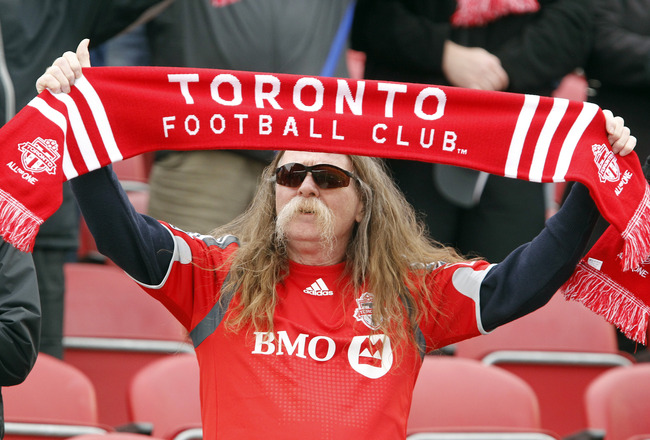
Y en reconocimiento de este 'clasico de sufrimiento' voy a llevar mi camiseta de Toronto FC; a ser hincha de TFC está en el diccionario bajo la palabra "sufrir".

____

Today is the "Clasico" between San Lorenzo de Almagro and Racing Club de Avellaneda. Unlike the 'superclasico' or 'clasico de Avellaneda', this clasico doesn't have a name. As I see it, tonight they will be playing the clasico of suffering and hope. One club, San Lorenoz, has a new manager, while Racing's could lose his job after tonight. Both are very far from the top of the table and are focused on staying in the Primera A. If San Lorenzo wins, they will rise in the ascenso while Racing needs the three points for next year's ascenso.

In my opinon, Carusso, San Lorenzo's new manager, is crazy. Maybe this is what San Lorenzo needs to win the final matches of the season but they need all the luck that they haven't been getting this year. They can only with their suffering with the hope that tomorrow they will be better.

In honour of the "clasico of suffering" I'm going to wear my TFC jersey, because in the dictionary below the word "suffer" is the definition "to be a supporter of TFC".


Image from: http://playfutbol.infobae.com/notas/641162-Racing-San-Lorenzo-un-clasico-de-necesitados-y-que-tendra ; http://bleacherreport.com/articles/1122548-struggling-reds-to-battle-mexican-power-santos-in-concacaf-semi-final-play

29.3.12

San Lorenzo es un equipo de sufrimiento

It is uncommon in Buenos Aires to encounter a taxi driver who does not associate with Boca or River. Not impossible: I've met taxi drivers from Racing, Independiente and even a handful from San Lorenzo; but uncommon. A taxi driver outside of the 'big five' is very rare. Taxi drivers are, at least in their football teams, representative of Argentine society.

In my first months in Buenos Aires, taxi drivers easily identified that I was not from the country (I can now give my address with a sufficient accent that their interest is not piqued). Conservation invariably reached the question: “what are you doing here?” and to football. Given the composition of taxi-drivers, I did not receive too much sympathy for my team choice. More, however, than an Argentine would.

Descriptive labelling is integral to Argentine conversation. Person's names are often replaced by ambivolent physical descriptions: “¡ey flaco!” “¿que tal gordo?” “bien bien, ¿y vos negro?” (Suaréz wasn't making up his defence from nothing, 'negro' is often used). Foreign players, and foreign immigrants, are often called by their nationality. Examples of San Lorenoz players: Ortigoza is called “el Paraguayo” and Salguiero is “el Uruguayo”. It is not always positive but unlike such labelling in North America it is also not always negative.

Hinchadas of football teams are also reduced to several descriptive labels. The most common and one of the most insulting is to say 'pecho frio' – literally cold chest, but I think cold heart is a more accurate translation. Vélez Sarsfield is the classic example – if they are losing “la gente” (people) don't go. At least that is how non-Vélez supporters see it. It may be jealousy, as Vélez has been consistently good since the 1990s. Nevertheless, for most hinchas what is worse than having a losing team is to have an hinchada that does not show its support through the 'buenas y en las malas mucho más' (in the good and in the bad, even more).

Two teams that don't consistently earn the label of 'pecho frio' from Buenos Aires taxi drivers are Racing Club de Avellaneda and San Lorenzo de Almagro – first because both are large enough to general topics of discussion. Instead most will agree they are clubs 'de sufrimiento' – of suffering – spoken with the tone of grave sincerity but approving nod of the head. In a twisted world, suffering is seen as an undesirable but admirable trait. In footballing terms, it means that people show up in the stadium to see their team lose.

And San Lorenzo is living up to its label this year. Last weekend I travelled to Rafaela, Santa Fe with buses organized by supporters – it is a seven hour trip of singing and drinking, on the way up at least. Around 600 people made the journey is a similar fashion (most from Buenos Aires and around, but others came from La Plata, Cordoba, Santa Fe, and other cities). We arrived early to pass the midday in a park. 600 cuervos eating choripan, relaxing in the autumn sun, sporadically groups launching into another song. While I heard people mention that they were nervous and anxious about the game, most came with an enduring hope that their collective presence would help lift their team.
It wasn't going to be a good result, despite pulling thousands (including many locals and people who found their own way) to Rafaela, their support was not enough to pull San Lorenzo back into the match that they briefly were leading. The 2-1 loss to Rafaela is a disaster in terms of San Lorenzo's position in the decenso; the team is within a hair (or another Tigre victory to be precise) of the direct decenso. No opportunity for redemption at the end of the season if the ciclón's fall continues.

The flow of the match has a big impact on how supporters react. I'm finding that an hinchada is willing to sing in matches that are a complete disaster (Lanús) but are disillusioned and likely to fall silent if their moment of hope is snatched away. San Lorenzo supporters walked out of Rafaela without singing, without applauding or even swearing at their players. “Why are you clapping, they don't deserve anything” someone said. Silence from thousands of people is one of the most imposing sounds.

How much suffering can people take, however, before they reach their limits? There are 12 matches to be played, the next one against the pecho frios of Vélez – still standing near the top of the table – behind closed gates. The incidents from two weekends ago led AFA to suspend local supporters. San Lorenzo supporters have a lot of potential suffering to endure – given how this team is playing and the troubles going on behind the scenes. They are not going to get any breaks; in Rafaela there was again more controversy with penalties not called in San Lorenzo's favour.

But as the bostero or gallina taxi drivers will admit, to a foreigner at least, there is an Argentine dignity to enduring suffering. I think to suffer means you do not have a cold heart, even more literally: not dead. With suffering there is passion and life, thus optimism that at the very least tomorrow and “siempre te voy a acompañar” - I will always be with you.

 Image from: http://larevistadelciclon.blogspot.com.ar/.

21.3.12

Injustice at the Nuevo Gasómetro?

Its three days after the controversial match between San Lorenzo de Almagro and Colón de Santa Fe ended in a tie. Colón scoring in the '69 minute from a potentially offside play waved off by the referee. After the match one article on Mundo Azulgrana finished:
Lo que se vivió el domingo ante Colón fue como diría Eduardo Galeano, el mundo del revés, Patas para Arriba: el que metió la mano se fue custodiado, y a los que se la metieron, reprimidos.
What I lived on Sunday against Colón was like what Eduardo Galeano wrote about in Upside Down, the world in reverse: he that did wrong was protected and those who were wronged were punished.

Undoubtably this match does nothing to abet the hincha's perspective that Club Atlético San Lorenzo de Almagro is the target of prejudice: A club regularly suffering against the injustices of authority. The narrative shared in the return to Boedo and to the stadium taken from the club by the dictatorship.

San Lorenzo needed a win against Colón to stay above Tigre, who is surging out of the promotion table. The very dangerous reality for San Lorenzo is not only that they are in the bottom four but that they may end up descending directly.

I think much worse than recognizing the need to win, for the hinchas there was also the feeling that they would win the match. Coming off two victories, a gutsy come-from behind triumph in Cordoba against Belgrano and a sloppy penalty-kick win in the Copa Argentina against Chacarita, there was some optimism. The banda had even changed its entering tune:

With lyrics like:
Hoy San Lorenoz hay que ganar Today San Lorenzo needs to win
No podemos perder We cannot lose
...
Yo dejo todo mi corazón I give you all my heart
Solo te pido salir campeón I only ask you to finish a champion

These hopes seemed realistic after Colón forward Fuertes was sent off for a hard body challenge in the 30th minute. El Ciclón had already the fair share of attacking opportunities, their chances improved greatly by going a man up in the hot afternoon sun with two-thirds of the match still to be played. More than anything else, however, finding the back of the net seems to be San Lorenzo's greatest problem. Their finishing in the box is dreadful.

It was an ugly goal but San Lorenzo found the advantage just before half. A strong strike from Kalinski ricocheted off of Colón defender Bastia into the back of the net. Underneath the rain of fire-hoses, La Gloriosa Butteler sang their team into the half-time locker room:


The 2-nil loss at home to Boca was forgotten, 4-1 in Lanús a distant memory, and in a couple of wins San Lorenzo would be out of the ascenso. In retrospect, all of the hope and good omens were only going to make what happened next worse.
In a short spell of Colón pressure coming out of the half, San Lorenzo was pushed back onto its defensive heals. San Lorenzo soaked up most of the pressure, but on a well defended attack, an innocuous blocked shot by a defenders head of would lead to a goal that has occupied sports news in Argentina for days.

From the perspective of the stands, it was impossible to understand what happened. Seeing Colón players celebrating led to an irruption of disbelief. Clearly Colón's player had been called offside by the linesman and his cross to Garcé in the middle was not serious. San Lorenzo's players had reacted to the raised flag by walking towards half, believing the play had ended. Even Garcé's tap-in was taken in the customary after the whistle style. But no whistle had been blown and the referee Abal had even wagged his finger at the linesman. Abal pointed to the centre signalling goal and was immediately surrounded by players. The stadium didn't know how to collectively react; every applicable insult and swear word was yelled simultaneously from every direction.

The goal is here:


Personally, I'm unsure about how the offside rule in this case should have been interpreted. The goal did come undeservedly against the run of play, the linesman did raise his flag to signal offside, and genuinely players from both teams did respond as if the play had ended. There is debate about how to interpret an “active” attacking player at the time the ball is passed forward, as clearly the Colón player was in an offside position. But there have been other times when a deliberate redirection by the defensive player to an offside but “unactive” attacker has not been called. A similar but different case is dealt with in #3 of You be the Ref.

What has really surprised me, however, is how the post-match reactions have failed to really pick up on two themes that are 'natural' from my North American “soccer” perspective: first San Lorenzo players did not play the whistle. Probably one of the most basic lessons any child would have heard their coach yell many many times. Second, they did not score a second goal despite playing a man up for 60+ minutes. Both of these problems I feel would have at least been raised in another cultural context to counter the sense of injustice experienced by San Lorenzo; in Argentina even in reading and listening to commentators normally against San Lorenzo these points were hardly raised.

Ending in a tie was a huge disappointment but the reaction in the stadium and after went to another level. Supporters in the normally posh Platea Norte refused to let the referees leave the pitch, throwing bottles other objects, and threats. Police with their shields were needed to escort Abal and crew off the field safely. Being in the Platea Sur, myself and friends were the most removed from the chaos and left the stadium fairly calmly. At a relative distance away from the stadium, I noticed people were focusing back onto the stadium, and that the police helicopter had come significantly closer. It was not until much later in the day that I saw the news: several hinchas of the Platea Norte had attempted to enter the change rooms.

The police response was heavy – they fired tear-gas and rubber bullets into the crowds. The populares, filled with barra bravas as well as families, by many accounts had not been involved but yet were nevertheless victims, having their eyes and throats burned by the gas. As I finish this post, the Asociación de Fútbol Argentino (AFA) is deciding whether San Lorenzo will face a two-match ban against local supporters. Supporters are already planning a march on AFA for this Friday in protest of the expected ban, with many writing: “without out hinchas, San Lorenzo doesn't play”. I'm not sure if the word ordering has the same effect in Spanish – turning the phrase from a threat into a statement of support.

It is going to be another interesting week with San Lorenzo. At the very least, next Saturday I'll be off to Rafaela (many Argentines have even asked, “where is that?”) to be with the visiting supporters.

8.3.12

Plaza de Mayo filled by Cuervos

This was the biggest march I've ever participated in - way more than all the anti-war mobilizations in Ottawa including George W. Bush's visit - and all organized by a group of supporters and members of a football and sports club. Somewhere between 65 000 (LaNacion, which buried the story) to well over the 100 000, all to hear 40 minutes of speeches and put pressure on a municipal government to take action. I'd expect some academic friends to easily make the argument "but there are things more important than a football stadium" - before anyone takes the cynical route, just imagine 100 000 people coming together, happy and energized, to participate in the political process to demand restitution from past injustices and possibilities for community in the future. It is worthy to congratulate the organizers on what all those with just political causes regularly fail to do, speak to the emotional passion that moves people to participate. The organizers proposed an idea 10 years ago and have worked, as volunteers in their own time, to make this:

I'll have more later. Hopefully an edited video from the caravan and analysis. It might take a bit of time because I'm off to see San Lorenzo play in Cordoba. For the moment: gracias gloriosa ciclón! sos tenes una hinchada sin igual, ¡que fiesta pendejo! A volver, a volver, San Lorenzo a volver!

20.2.12

8 de Marzo - the Day the Hinchas Play

SanLorenzoTV, a supporter made youtube channel/website, and the Cuervos de Poe have put together a 'commercial' for the March 8th march supporting the 'vuelta a Boedo' - return to Boedo.


As if out of classic western, the fight against injustice is put forth:
"Their stadium was robbed" / "They swore to not stop till they won it back"

San Lorenzo lost their stadium in 1979 during some shady political business during the military dictatorship in Argentina; it has been long standing grievance for hinchas and in the recent years they have organized a social and political campaign to regain the property. Right now, a Carrefour shopping store, similar to a Wal-Mart, is under partial reconstruction where the "Gasómetro" once stood. Images of the old stadium define the historical memory of the club in its neighbourhood home of Boedo, the "historical restitution" of the "holy land" to San Lorenzo is also called "the return to Boedo".

Several marches have been organized in the past year or so to put pressure on the current city government to pass the law and figure out a way of returning the property to San Lorenzo. Starting at a few thousand, the second march in May last year was attended by 20 000 people and then 40 000 in June. Last December, more than 7000 people showed up to deliver a letter to the French embassador, outlining the case against the French company Carrefour. Ultimately, hinchas would like to construct a modern stadium on the Avenida La Plata.

On March 8th, another march is being organized by supporters. Advertising is sprinkled throughout the city and around the world - around 80 buses advertise the date, stickers and posters have been glued up, the date has been sprayed onto walls, and banners have been painted and displayed along highways, in towns in the provinces and as far away as Paris and Barcelona. Tables have been organized for the proceeding two weeks in the city centre and in Boedo to get information about the proposed law and campaign. Organizers are calling for 100 000 people.

No fight against injustice is complete without its heroes. The commercial stars some of the most recognizable 'characters' of San Lorenzo's hinchada, including the unstoppable "gordo ventilador" (the big fan), legendary 1970s player "el Sapo" (the frog) Villar, and members of the "Los Chiflados" murga. The rest of the captions read: "There is no flu / ...work... /... or exam that can stop us" "the return is supported by the people" "rise up 'cuervos' and occupy the Plaza de Mayo" "On March 8th, the supporters will play" ... "our faith moves supermarkets".

A work of (political) art.

11.2.12

An Argentine definition of "sufrir"

The hinchada of San Lorenzo, along with Racing de Avellaneda, is broadly known for its suffering. Last night San Lorenzo lost 4-1 in a 30 minute defensive disaster.

Here is the response (you can hear San Lorenzo's goal, but it wasn't what mattered):


Unlike in English, in Argentina to recognize someone's 'suffering' is not to see only their problems; it is also to recognize their willingness to struggle against those problems.

9.2.12

Introduction - in the murga y carnaval

In the Murga y Carnaval intends to cover the Argentine football world, with an emphasis on Club Atlético San Lorenzo de Almagro, from the perspective of a Canadian ‘hincha’ in training. Hincha (pronounced een-cha) is the Argentine word for soccer/football ‘supporter’ or ‘fanatic’ and is derived from the verb hinchar, which translates literally to mean “to swell” or “to fill up”. The collective of the hinchas is known as an hinchada (een-cha-da).


The title of this blog is taken from a song sung by the hinchada of San Lorenzo:

Vengo del barrio de Boedo I come from the neighbourhood of Boedo

Barrio de murga y carnaval Neighbourhood of murga and carnaval

Te juro que en los malos momentos I swear to you in the bad times

Siempre te voy a acompañar I will always be with you

dale dale matador

dale dale matador

dale dale dale dale matador


The hinchada of San Lorenzo singing 20 Nov 2011


Matador being one of the pseudonyms of San Lorenzo, named for the 1968 Torneo Metropolitano winning team, which won the without losing a game, a first in Argentina’s professional era, and earning the name Los Matadores, “the killers” (the poetics don’t always translate).


Murgas are the typical music and dance collective that perform during the carnival celebrations in the cities of the River Plate. Murgas originated in the working-class ‘barrios’ of Montevideo and Buenos Aires as a cultural syncretism of European carnival and various forms of African percussive music. African populations brought to the Americas as slaves represented a significant portion of the Argentine population during the 18th and 19th century. Many Afro-Argentines settled in the neighbourhoods of Monseratt and San Telmo and interacted with working-class Argentines; by the end of the 19th century, however, the Afro-Argentine population had significantly declined (large number of blacks died in the armies of Argentina, faced racism and lower standards of living, which led to a high mortality during the yellow fever epidemics). Murgas, epitomized by the booming rhythms of the “bombos” – large base drums, continued to be important social organizations in working class neighbourhoods throughout Buenos Aires, particularly in the south of the city, in part because of their role as social critics.


During the military dictatorship of the 1970s and 80s, the custom of using murgas as social organizations and the songs sung by murgas as a form of social critique from the lower classes led to the ban of murgas and carnaval throughout Argentina. As a result, murga, along with candombé groups, have been more recently associated to carnival across the river in Montevideo. Murgas are, however, experiencing resurgence in the barrios of Buenos Aires.


Protest, cultural inversion, and contestation are constant themes of carnivals around the world; the murga is not an exception. Following in this tradition, I wish to use this blog to highlight the cultural, social, economic, and political complexities as they flow through and out of Argentine football. Being an hincha in Argentina, and arguably everywhere in the world, is not an experience ambivalent to the struggles of power, inequality, justice, and dignity. Fandom is shaped by and speaks to the broad social context and I bring my own critical view on many issues into the discussions.


The music of the murga has long been associated with the sound of the cancha – the field and stadium. The constant rhythmic boom of the banda – the musicians of the hinchada –underscores most canciones – songs – of an Argentine hinchada. Wherever a match is being played in Argentina, the historical influence of the murga will be heard.


I am an anthropology PhD candidate at Carleton University in Ottawa, Canada. I am currently in the middle of my thesis research into the culture of Argentine hinchas. Most of my football time is with la gente of San Lorenzo.


Periodically this blog will contain articles written in my broken castellano.